10 Porutham in Tamil Marriage – Simple Guide to All 10
Learn the meaning of all 10 Tamil marriage poruthams, their traditional importance, Rajju Dosham, matching rules and common marriage compatibility questions.
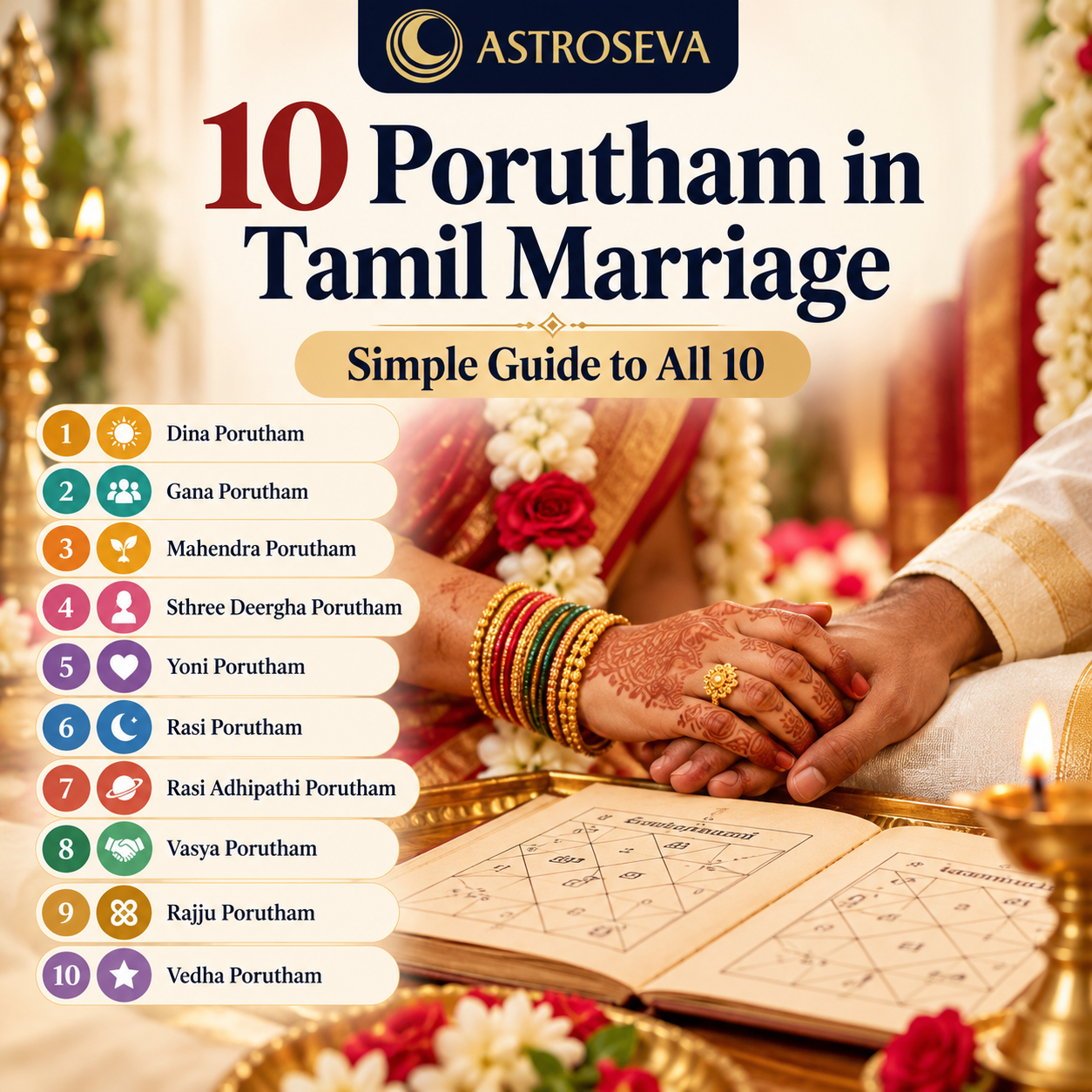
A simple guide to the 10 traditional marriage poruthams, their importance and what Tamil families should know before matching horoscopes.
"Jathagam porutham paarthacha?"
This is often one of the first questions asked when a marriage proposal arrives in a Tamil family.
The families may like each other. The bride and groom may have spoken and found common interests. The wedding discussions may even be moving forward. But before fixing the engagement, there is often one more important step: Jathaga Porutham (ஜாதகப் பொருத்தம்).
For generations, Tamil families have followed the traditional practice of matching the bride's and groom's horoscopes. Among the different methods, the 10 Porutham system is widely known.
But what are these 10 poruthams? Why do astrologers check them? Is it necessary for all 10 to match?
Let's understand them one by one.
What Are the 10 Poruthams?
In Tamil astrology, marriage compatibility is traditionally assessed by comparing the bride's and groom's birth stars (Nakshatram) and Rasi (Moon sign).
The 10 poruthams are:
- Dina Porutham
- Gana Porutham
- Mahendra Porutham
- Sthree Deergha Porutham
- Yoni Porutham
- Rasi Porutham
- Rasi Adhipathi Porutham
- Vasya Porutham
- Rajju Porutham
- Vedha Porutham
Each porutham has a different traditional meaning. Some relate to well-being and prosperity, while others focus on temperament, attraction or specific astrological combinations.
Let's look at what each one means.
The 10 Poruthams Explained
1. Dina Porutham – Will the Couple Enjoy a Harmonious Life?
Dina Porutham is traditionally associated with health, happiness and general well-being.
It is calculated by counting the distance between the bride's and groom's birth stars. Certain counts are considered favourable under traditional rules.
In simple terms, Dina Porutham is believed to indicate whether the couple's stars are favourably aligned for a harmonious married life.
2. Gana Porutham – Are Their Temperaments Compatible?
Have you ever heard elders say, "Avanga gunam eppadi irukkum?" (What will their nature be like?)
Gana Porutham is traditionally associated with temperament.
The 27 Nakshatras are divided into three groups:
- Deva Gana: Traditionally associated with gentle and calm qualities.
- Manushya Gana: Associated with practical and balanced qualities.
- Rakshasa Gana: Associated with assertive and independent qualities.
The astrologer compares the bride's and groom's Ganas to assess traditional compatibility.
Of course, a person's real nature cannot be determined simply by their birth star. Understanding each other's personality through conversation and shared experiences matters in a relationship.
3. Mahendra Porutham – What About Family Growth?
Mahendra Porutham is traditionally associated with family growth, prosperity and progeny.
The astrologer counts the groom's birth star from the bride's birth star. Certain counts, such as 4, 7, 10, 13, 16, 19, 22 and 25, are traditionally considered favourable.
For many families, this porutham is part of their traditional assessment of a couple's future family life.
It is important to remember that it cannot predict fertility or guarantee that a couple will have children.
4. Sthree Deergha Porutham – A Traditional Check for the Bride's Well-Being
Sthree Deergha Porutham is traditionally associated with the bride's well-being, prosperity and comfort in married life.
It is calculated based on the distance between the birth stars.
Under a commonly followed rule, the groom's Nakshatram should be more than 13 positions from the bride's Nakshatram for this porutham to be considered favourable.
Different traditions may use different rules or exceptions.
The name and its traditional interpretation reflect historical beliefs. They should not be taken as a prediction of a woman's lifespan or actual future.
5. Yoni Porutham – Is There Physical Compatibility?
Yoni Porutham is associated with physical compatibility and mutual attraction in traditional astrology.
Each Nakshatram is assigned an animal symbol. The astrologer compares the symbols of the bride and groom to determine whether the combination is traditionally considered friendly, neutral or incompatible.
This porutham is often discussed in connection with intimacy and physical harmony.
However, real intimacy depends on mutual attraction, trust, respect and communication, not on birth-star classifications alone.
6. Rasi Porutham – How Do Their Moon Signs Match?
Rasi Porutham compares the bride's and groom's Janma Rasis.
For example, a bride may belong to Rishabam Rasi while the groom belongs to Kanni Rasi.
The astrologer examines the relative positions of the two Rasis using traditional rules.
Rasi Porutham is associated with harmony, prosperity and family well-being.
Certain combinations are traditionally regarded as favourable, while others require further examination.
7. Rasi Adhipathi Porutham – What About Their Rasi Lords?
Every Rasi has a ruling planet in traditional astrology.
For example:
- Mesham is ruled by Sevvai (Mars).
- Rishabam is ruled by Sukran (Venus).
- Mithunam is ruled by Budhan (Mercury).
- Kadagam is ruled by Chandran (Moon).
- Simham is ruled by Suriyan (Sun).
Rasi Adhipathi Porutham examines the relationship between the ruling planets of the bride's and groom's Rasis.
Traditional astrology classifies planetary relationships as friendly, neutral or inimical.
This porutham is believed to represent mutual understanding and cooperation.
8. Vasya Porutham – Is There Mutual Attraction?
Vasya Porutham is traditionally associated with attraction, affection and mutual influence.
Certain Rasi combinations are considered favourable according to traditional Vasya classifications.
The idea is that a favourable combination may indicate a natural inclination towards each other.
In real life, attraction and affection grow through shared interests, trust, respect and emotional connection. A horoscope cannot establish these qualities on its own.
9. Rajju Porutham – Why Do Astrologers Pay Special Attention to It?
Among the 10 poruthams, Rajju Porutham receives particular attention in many Tamil marriage-matching traditions.
The 27 Nakshatras are divided into five Rajju groups:
- Pada Rajju
- Ooru Rajju
- Nabhi Rajju
- Kanta Rajju
- Siro Rajju
Traditionally, these are associated with different parts of the body.
If the bride and groom belong to the same Rajju group, the match is commonly classified as Rajju Dosham under standard rules.
Many traditional astrologers consider this a significant factor and examine it carefully, even if several other poruthams match.
For example, if both the bride and groom have the same Nakshatram, they will necessarily belong to the same Rajju group.
This is why families often seek a detailed explanation when the couple share the same birth star.
These are traditional astrological beliefs, not scientifically proven predictions of marital longevity or harm.
10. Vedha Porutham – Are There Any Traditional Star Conflicts?
Vedha Porutham examines specific pairs of Nakshatras that are traditionally considered incompatible.
Certain birth stars are classified as Vedha pairs. When the bride's and groom's stars form one of these combinations, the astrologer may identify Vedha Dosham.
This porutham is traditionally associated with avoiding obstacles and promoting harmony.
The calculation depends on specific Nakshatra pairing rules.
How Many Poruthams Should Match?
This is perhaps the most common question parents ask.
"10-la ethana porutham match aaganum?"
There is no single rule followed by every Tamil astrologer or family.
Some traditional practices use a minimum number of matching poruthams as a guideline. Others place greater importance on specific factors such as Rajju or Dina Porutham.
For example, a match with seven favourable results is not automatically considered suitable in every tradition if a particular factor raises concern.
Similarly, a lower number of matching poruthams does not automatically mean every astrologer will reject a match.
The actual interpretation depends on the individual results, calculation rules and the wider horoscope if the family follows full horoscope matching.
The important thing is to understand which poruthams match and which do not, rather than looking only at the final count.
What If the Bride and Groom Have the Same Rasi and Nakshatram?
Imagine a family finding a marriage proposal where both the bride and groom have the same Rasi and Nakshatram.
Is that a good match or a bad match?
There is no simple answer under traditional matching rules.
When both share the same birth star:
- Their Gana classifications will be the same.
- Their Yoni classifications will be the same.
- Their Rasi lords will be the same.
- They will belong to the same Rajju group.
Some of these similarities may be considered favourable in particular matching factors, while the same Rajju group is generally treated as a concern under standard Rajju rules.
Astrologers may also examine the full horoscopes and any traditional exceptions.
Therefore, the same Rasi and Nakshatram should not be judged simply by counting the number of matching poruthams.
Is 10 Porutham Enough to Decide a Marriage?
In traditional Tamil astrology, 10 Porutham is an important part of marriage matching. Some astrologers also examine the complete horoscopes, including:
- Lagnam
- Seventh house
- Chevvai Dosham
- Dasa and Bhukti
- Navamsam
- Other planetary placements
These additional factors are part of traditional horoscope interpretation, and their use varies among astrologers.
But marriage is much more than a horoscope.
Before making a decision, couples and families should also consider communication, shared values, financial expectations, family responsibilities, personal goals and mutual respect.
A favourable horoscope match cannot guarantee a successful marriage, just as a mismatch is not scientific evidence that a marriage will fail.
Frequently Asked Questions
Which is the most important porutham in Tamil marriage?
Rajju Porutham and Dina Porutham receive particular attention in many Tamil traditions. However, the importance assigned to each factor varies among astrologers.
Can a marriage happen with only 5 out of 10 poruthams?
Some traditional systems use minimum matching counts, while others assess individual factors and the complete horoscope. There is no universal numerical cutoff followed by all Tamil traditions.
What happens if Rajju Porutham does not match?
A same-Rajju combination is traditionally identified as Rajju Dosham under standard matching rules. Families who follow this practice may consult an astrologer about their specific charts and any accepted exceptions.
Is Tamil 10 Porutham the same as 36 Guna matching?
No. Tamil 10 Porutham and North Indian Ashtakoota Guna Milan use different compatibility factors and calculation methods.
Can we check marriage porutham online?
Yes. Online horoscope matching tools can calculate traditional compatibility results using birth details. Check the calculation method and the individual porutham explanations rather than relying only on a total score.
Final Thoughts
For many Tamil families, Jathaga Porutham is an important tradition that connects marriage decisions with generations of cultural practice.
Understanding the 10 poruthams makes it easier to follow what an astrologer is explaining and to ask meaningful questions when reviewing a marriage match.
Whether you are a parent checking a proposal, a bride or groom exploring compatibility, or simply curious about Tamil astrology, knowing the basics of the 10 poruthams is a useful starting point.
A horoscope may be part of the marriage discussion, but a good marriage is ultimately built through understanding, trust, respect and the willingness to grow together.