Lord Ganesha: The Remover of Obstacles, Wisdom & New Beginnings | AstroSEVA
Discover the spiritual significance of Lord Ganesha, Vinayagar, his elephant head, trunk, large ears, modak and mouse, and why he is worshipped before new beginnings.
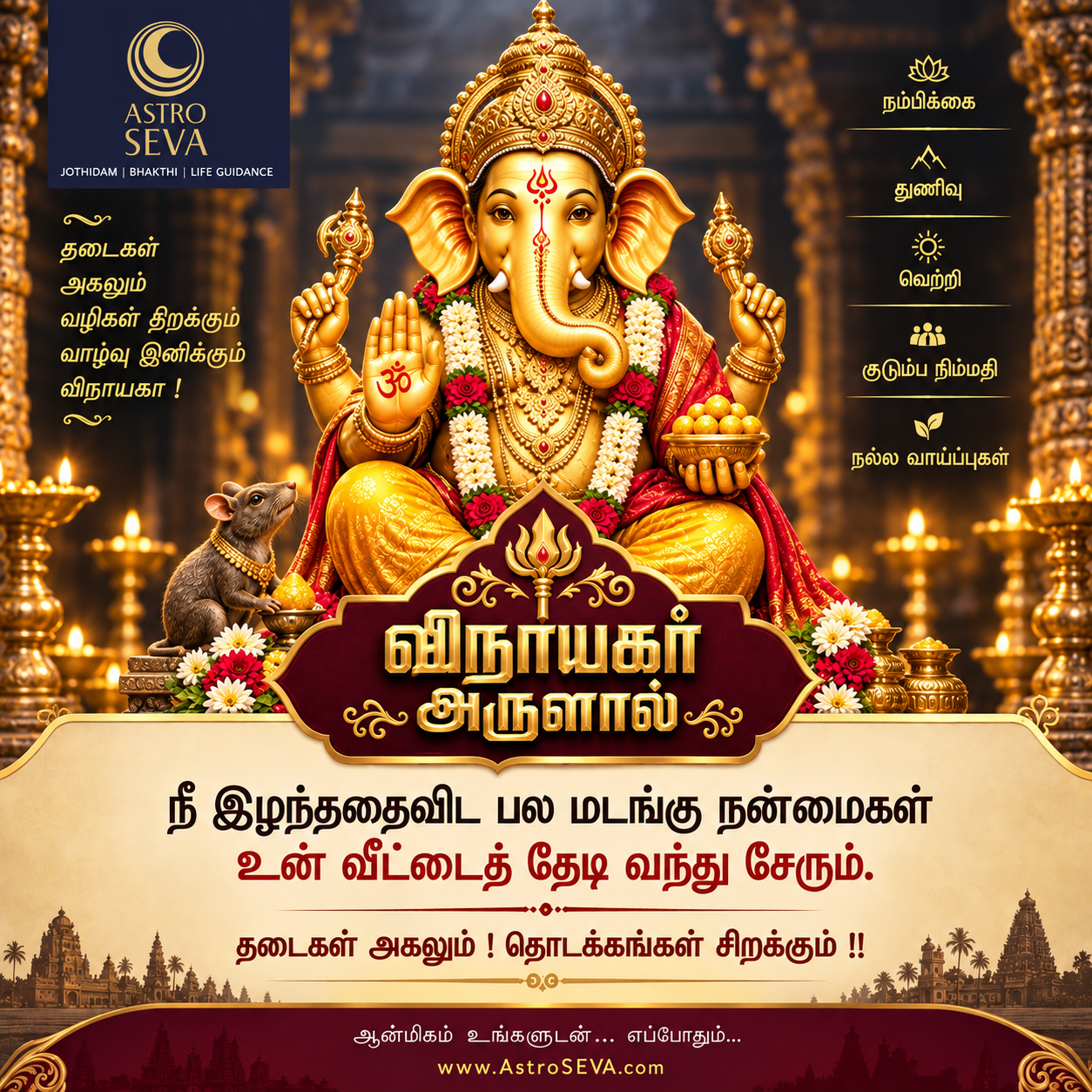
SPIRITUALITY • DEVOTION • HINDU TRADITIONS
Lord Ganesha: The Divine Power of Wisdom, New Beginnings & Removing Obstacles
Vinayagar • Pillaiyar • Ganapathy • Vigneshwara
Before a new journey begins, millions of people across India instinctively remember one divine form — Lord Ganesha.
With his elephant head, gentle smile, large ears, curved trunk and unmistakable presence, Ganesha is one of the most beloved deities in Hindu tradition.
In Tamil Nadu, he is lovingly called Vinayagar or Pillaiyar. He is remembered before a new business, a wedding, an examination, a housewarming, a journey, a religious ceremony or simply a new chapter in life.
But why is Ganesha worshipped before beginnings? Why are modakam, arugampul, flowers and coconut offered? Why is Chaturthi considered especially important? And why do certain Ganesha temples attract devotees seeking particular blessings?
The answers reveal a fascinating combination of mythology, symbolism, ritual and timeless life wisdom.
Who Is Lord Ganesha?
Lord Ganesha is one of the most widely worshipped deities in Hindu traditions. He is known by many names including Ganesha, Ganapati, Vinayaka, Vinayagar, Pillaiyar, Vigneshwara and Ekadanta.
He is traditionally described as the son of Lord Shiva and Goddess Parvati.
Ganesha is associated with wisdom, intellect, auspicious beginnings and the removal of obstacles. This is why his presence is particularly important at the beginning of prayers, ceremonies and important ventures.
Why Do Hindus Worship Ganesha First?
One of the most enduring traditions in Hindu worship is to invoke Ganesha before beginning an important undertaking.
The traditional idea is simple: remove the obstacles before beginning the journey.
This practice is known as invoking the deity as Vighneshwara — the Lord associated with obstacles and their removal.
The deeper message is equally powerful. Before beginning something important, a person should pause, clear the mind, establish the intention and proceed with discipline.
The Extraordinary Symbolism of Ganesha
Few Hindu deities contain as many visual symbols as Ganesha. Almost every part of his form carries a philosophical interpretation.
The Elephant Head
The elephant is associated with intelligence, strength, memory and wisdom.
Ganesha's elephant head reminds us that true strength should be guided by intelligence.
The Large Ears
Large ears are traditionally interpreted as a reminder to listen more and speak thoughtfully.
A wise person does not rush to respond before understanding.
The Trunk
The trunk combines strength and delicacy. It can perform powerful tasks while also handling something delicate.
It reminds us to be strong when necessary and flexible when required.
The Large Belly
Ganesha's large belly is traditionally associated with the ability to absorb and digest the experiences of life.
Happiness and hardship both become part of our journey.
The Single Tusk
Ganesha is often called Ekadanta, meaning “one-tusked”.
The broken tusk is traditionally connected with stories of sacrifice, determination and the pursuit of knowledge.
The Mouse
Ganesha's vehicle, the mouse, is a fascinating contrast to his enormous form.
It can be interpreted as a reminder that even the smallest force can become powerful when properly directed.
Why Is Modakam Offered to Ganesha?
Among all offerings associated with Ganesha, the modakam or kozhukattai has a special place.
In Tamil homes and temples, devotees often prepare sweet kozhukattai made with rice flour and fillings such as jaggery and coconut.
The sweet filling hidden inside the outer covering offers a beautiful symbolic interpretation:
Offering food is also an expression of gratitude. Devotional traditions encourage devotees to receive the offering as prasadam with reverence rather than simply viewing it as a material transaction.
Traditional Offerings Made to Lord Ganesha
Different regions and temples have their own customs, but several offerings are particularly associated with Ganesha worship.
Modakam / Kozhukattai
A traditional sweet offering associated strongly with Ganesha.
Arugampul
Sacred Bermuda grass is widely offered to Ganesha in many traditions.
Coconut
Coconut is commonly used as an auspicious offering in Hindu worship.
Bananas & Fruits
Fresh fruits are commonly offered as part of puja and prasadam.
Flowers
Flowers are offered as an expression of devotion, purity and reverence.
Turmeric
Turmeric has an important place in traditional Hindu household worship and auspicious ceremonies.
Ganesha Rituals People Follow for Blessings
Across Hindu communities, devotees follow different forms of Ganesha worship depending on family tradition, temple custom and regional practice.
These practices should be understood as expressions of faith and devotion, rather than guaranteed methods for producing a particular material result.
Lighting a Lamp
Devotees may light a lamp before beginning prayer. The flame symbolises light, awareness and the removal of darkness.
Offering Arugampul
Arugampul is traditionally offered to Ganesha as part of daily and special worship.
Offering Modakam
Devotees prepare or offer modakam and receive it as prasadam after worship.
Chanting Ganesha Mantras
One widely used mantra is:
Repetition of a mantra can also serve as a practice of concentration and meditation.
Archana
Devotees may participate in archana at temples, where the deity's names are recited while offerings are made.
Ganapathi Homam
Ganapathi Homam is performed in many traditions as a fire ritual invoking Ganesha and seeking auspiciousness before important undertakings.
Breaking a Coconut
In many Hindu traditions, breaking a coconut is associated with surrendering the ego and offering one's intention to the divine.
Charity & Sharing
Offering food, helping someone in need and sharing prasadam can turn private devotion into a meaningful act of service.
Which Days Are Special for Ganesha Worship?
Ganesha can be worshipped on any day. However, certain days and observances are especially important in Hindu tradition.
Vinayaka Chaturthi
The most prominent annual celebration dedicated to Ganesha. It is observed on Shukla Chaturthi in the month of Bhadrapada, generally falling in August or September.
Sankatahara Chaturthi
The fourth lunar day of the waning fortnight is observed by many devotees as a special day for Ganesha worship, particularly for seeking relief from difficulties.
Monthly Chaturthi
Chaturthi occurs every lunar month and is considered especially significant for Ganesha worship.
Tuesday & Friday Traditions
Some families and local traditions give special importance to particular weekdays. Practices vary by region, temple and family custom.
Vinayaka Chaturthi — The Grand Festival of Ganesha
Vinayaka Chaturthi is the most celebrated festival dedicated to Lord Ganesha.
In many traditions, devotees install a Ganesha idol, perform prayers, offer flowers and food, conduct aarti and celebrate with family and community.
Public celebrations can continue for several days, culminating in Visarjan, the ceremonial immersion of the idol.
In Tamil Nadu, Vinayagar Chaturthi is also celebrated with great enthusiasm. Pillayarpatti, in particular, is renowned for its grand Vinayagar Chaturthi celebrations.
Famous Ganesha Temples in Tamil Nadu
Tamil Nadu has a remarkable tradition of Vinayagar temples. Some are famous for their ancient architecture, some for their unique forms of Ganesha, and others for specific festivals and devotional traditions.
Karpaga Vinayagar Temple — Pillayarpatti
Located in Sivaganga district, the Karpaga Vinayagar Temple is one of Tamil Nadu's most celebrated Ganesha temples.
The ancient rock-cut shrine and its distinctive Ganesha image make this temple particularly significant.
The temple is also famous for its grand Vinayagar Chaturthi celebrations.
Ucchi Pillayar Temple — Tiruchirappalli
Perched dramatically on the Rockfort hill in Tiruchirappalli, Ucchi Pillayar Temple is one of the most recognisable Ganesha temples in Tamil Nadu.
Its hilltop setting, historic surroundings and association with the Ramayana tradition make it an important pilgrimage destination.
Manakula Vinayagar Temple — Puducherry
The Manakula Vinayagar Temple is one of the best-known Ganesha temples in Puducherry.
The temple has a long devotional history and is particularly associated with the city's Tamil and French-era cultural landscape.
Ganapathy Agraharam — Thanjavur Region
Ganapathy Agraharam is associated with a strong tradition of Ganesha worship in the Cauvery delta region.
The area is particularly respected among devotees who value traditional forms of Ganapathy worship.
Adhi Vinayagar Temple — Poongulam / Thiruvanaikaval Region
Several ancient Tamil temples preserve distinctive forms and traditions of Vinayagar worship. Devotees often visit these temples seeking blessings before important life events.
Why Is Pillayarpatti So Special?
Among Tamil Nadu's Ganesha temples, Pillayarpatti Karpaga Vinayagar Temple holds a particularly distinctive place.
The temple is an ancient rock-cut cave shrine, and its principal Ganesha image is carved from the rock itself.
The temple's annual Vinayagar Chaturthi festival is celebrated on a grand scale, with processions, special worship and cultural events.
For many devotees, Pillayarpatti is not simply a place to ask for blessings. It is a place to experience the continuity of Tamil temple culture across centuries.
What Can Ganesha Teach Us About Modern Life?
Perhaps the greatest reason Ganesha remains relevant is that his symbolism speaks directly to everyday human challenges.
Listen Before You Speak
His large ears remind us that understanding often begins with listening.
Think Before You Act
Wisdom is not simply knowledge. It is knowing when and how to use it.
Be Flexible
The trunk represents the ability to adapt without losing strength.
Accept Life
Happiness, disappointment, success and failure are all part of the human journey.
Control the Mind
The mouse beneath Ganesha symbolises a small but restless force brought under control.
Start Anyway
Waiting for perfect circumstances can become its own obstacle. Begin with clarity and sincerity.
Ganesha and New Beginnings
There is a reason Ganesha is remembered at the beginning of so many important occasions.
A beginning carries uncertainty. A new business may succeed or fail. A marriage begins a new chapter. A student faces an unknown result. A family moving into a new home begins a new phase of life.
Ganesha worship creates a moment to pause before stepping into that uncertainty.
A Simple Ganesha Puja at Home
A simple home prayer does not need to be elaborate. Families may follow their own traditions and, when necessary, seek guidance from their family priest or temple.
- Clean the prayer area and create a calm environment.
- Place the Ganesha image or idol respectfully.
- Light a lamp and, according to family custom, incense.
- Offer flowers and arugampul.
- Offer fruit, coconut or modakam as appropriate.
- Chant a Ganesha mantra with concentration.
- Perform a simple aarti or prayer.
- Share the prasadam with family members.
Faith, Ritual and the Meaning of “Benefits”
Devotees may pray to Ganesha for many things — success in education, career progress, business growth, marriage, family harmony, financial stability and relief from difficulties.
Hindu devotional traditions describe these as blessings that may be sought through sincere worship. However, spiritual practices should not be treated as a guaranteed formula for a particular material result.
The deeper value of ritual can also be found in the qualities it encourages:
- Faith during uncertainty
- Discipline in daily life
- Gratitude for what we receive
- Humility when we succeed
- Patience when results take time
- Compassion towards others
In that sense, Ganesha worship is not simply about asking for life to become easier.
A Prayer to Lord Ganesha
Ganesha, Lord of wisdom and auspicious beginnings,
Remove the confusion from my mind.
Give me the wisdom to choose the right path.
Give me the courage to walk that path.
Give me the patience to continue when progress is slow.
Give me humility when I succeed.
And give me strength when life becomes difficult.
May my home be filled with peace.
May my work be guided by integrity.
May my efforts bring benefit not only to me,
but also to those around me.
The Beautiful Message of Vinayagar
Perhaps the most beautiful lesson of Ganesha is that obstacles are not always the enemy.
Sometimes an obstacle tells us to change direction. Sometimes it teaches patience. Sometimes it forces us to become stronger. And sometimes it protects us from a path that was never meant for us.
Ganesha reminds us to approach every beginning with wisdom instead of fear.
And when the road becomes difficult, remember the deity who has been invoked before countless beginnings across generations:
Ganapathi Bappa Morya!
May Lord Ganesha bless your home with peace, your mind with clarity, your work with wisdom and your journey with courage.
May every new beginning be guided by good intentions, sincere effort and divine grace.
Sri Vinayaga Potri!
Onbathu Kolum
Lord Vinayagar | Ganapathi | Pillayar |Tamil Devotional